#include <triqs/mesh/imfreq.hpp>
Detailed Description
Imaginary frequency mesh type.
An imaginary frequency mesh is defined by the number of positive frequencies \( N_{i\omega_n} \geq 0 \), the inverse temperature \( \beta > 0 \), its particle statistics and an option (all_frequencies vs positive_frequencies_only).
An imaginary frequency mesh has the following properties:
- Each mesh point is identified by a unique index \( n \in \{ n_{\text{min}}, n_{\text{min}} + 1, \dots, n_{\text{max}} - 1, n_{\text{max}} \} \), where \( n_{\text{max}} = N_{i\omega_n} - 1 \) and
\[ n_{\text{min}} = \begin{cases} -N_{i\omega_n} & \text{if fermionic statistics and all frequencies} \\ -N_{i\omega_n} + 1 & \text{if bosonic statistics and all frequencies} \\ 0 & \text{if positive frequencies only} \end{cases} \; . \]
- The size of the mesh is \( N = n_{\text{max}} - n_{\text{min}} + 1 \).
- An index \( n \) is mapped to the corresponding data index \( d \) by the function \( d(n) = n - n_{\text{min}} \). The inverse map is \( n(d) = d + n_{\text{min}} \).
- An index \( n \) is mapped to the corresponding value \( i\omega_n \equiv i\omega(n) \) by the function
\[ i\omega_n = \begin{cases} i\frac{2n \pi}{\beta} & \text{if fermionic statistics} \\ i\frac{(2n + 1) \pi}{\beta} & \text{if bosonic statistics} \end{cases} \; . \]
Green's function containers that are based on an imaginary frequency mesh store the function values at the discrete frequency points \( i\omega_n \), i.e. \( f_n = f(i\omega(n)) \), and to evaluate the function at a specific Matsubara frequency \( i\omega_n \) with \( n_{\text{min}} \leq n \leq n_{\text{max}} \) the container simply returns the corresponding \( f_n \).
Definition at line 102 of file imfreq.hpp.
Classes | |
| class | mesh_point_t |
| Mesh point of a triqs::mesh::imfreq mesh. More... | |
Public Types | |
| using | data_index_t = long |
| Data index type. | |
| using | index_t = long |
| Index type. | |
| enum class | option |
| Enum to specify which frequencies should be included in the mesh. More... | |
| using | value_t = matsubara_freq |
| Value type. | |
Public Member Functions | |
| imfreq ()=default | |
| Default constructor constructs an empty mesh. | |
| imfreq (double beta, statistic_enum statistic, energy_t w_max, option opt=option::all_frequencies) | |
| Construct an imaginary frequency mesh with a threshold for the largest positive Matsubara frequency on the mesh. | |
| imfreq (double beta, statistic_enum statistic, long n_iw=1025, option opt=option::all_frequencies) | |
| Construct an imaginary frequency mesh with \( N_{i\omega_n} \geq 0 \) positive Matsubara frequencies. | |
| auto | begin () const |
| Get an iterator to the beginning of the mesh. | |
| double | beta () const noexcept |
| Get the inverse temperature \( \beta \). | |
| auto | cbegin () const |
| Get a const iterator to the beginning of the mesh. | |
| auto | cend () const |
| Get a const iterator to the end of the mesh. | |
| void | deserialize (auto &ar) |
| Deserialize the mesh from a generic archive. | |
| auto | end () const |
| Get an iterator to the end of the mesh. | |
| bool | eval_to_zero (index_t n) const |
| Return true if the given Matsubara index \( n \) is not valid (see is_index_valid()). | |
| bool | eval_to_zero (matsubara_freq iw) const |
| Return true if the Matsubara index of the given Matsubara frequency \( i\omega_n \) is not valid. | |
| bool | eval_to_zero (mesh_point_t mp) const |
| Return true if the Matsubara index of the given mesh point is not valid (see is_index_valid()). | |
| long | first_index () const |
| Get the first Matsubara index, i.e. \( n_{\text{min}} \). | |
| imfreq | get_positive_freq () const |
| Get a new mesh with the same \( \beta \), particle statistics and \( N_{i\omega_n} \) but only positive frequencies. | |
| bool | is_index_valid (index_t n) const |
| Check if a Matsubara index \( n \) is valid. | |
| long | last_index () const |
| Get the last Matsubara index, i.e. \( n_{\text{max}} \). | |
| uint64_t | mesh_hash () const noexcept |
| Get the hash value of the mesh. | |
| long | n_iw () const noexcept |
| Get the number of positive Matsubara frequencies \( N_{i\omega_n} \). | |
| mesh_point_t | operator() (long n) const |
| Function call operator to access a mesh point by its Matsubara index \( n \in \{ n_{\text{min}}, \dots,
n_{\text{max}} \} \). | |
| bool | operator== (imfreq const &m) const |
| Equal-to comparison operator compares \( \beta \), the particle statistics, \( N_{i\omega_n} \) and whether all or only positive frequencies are in the mesh. | |
| mesh_point_t | operator[] (closest_mesh_point_t< value_t > const &cmp) const |
| Subscript operator to access a mesh point by a Matsubara frequency \( i\omega_n \) contained in a triqs::mesh::closest_mesh_point_t. | |
| mesh_point_t | operator[] (long d) const |
| Subscript operator to access a mesh point by its data index \( d \in \{0, 1, \ldots, N-1\} \). | |
| bool | positive_only () const |
| Is the mesh restricted to positive Matsubara frequencies? | |
| void | serialize (auto &ar) const |
| Serialize the mesh to a generic archive. | |
| long | size () const noexcept |
| Get the size \( N \) of the mesh, i.e. the total number of mesh points. | |
| statistic_enum | statistic () const noexcept |
| Get the particle statistics. | |
| data_index_t | to_data_index (closest_mesh_point_t< value_t > const &cmp) const |
| Map a Matsubara frequency \( i\omega_n \) contained in a triqs::mesh::closest_mesh_point_t to its data index \( d(i\omega_n) \). | |
| data_index_t | to_data_index (index_t n) const noexcept |
| Map a Matsubara index \( n \in \{ n_{\text{min}}, \dots, n_{\text{max}} \} \) to its corresponding data index \( d(n) \). | |
| data_index_t | to_data_index (matsubara_freq const &iw) const noexcept |
| Map a Matsubara frequency \( i\omega_n \) to its data index \( d(i\omega_n) \). | |
| index_t | to_index (closest_mesh_point_t< value_t > const &cmp) const |
| Map a Matsubara frequency \( i\omega_n \) contained in a triqs::mesh::closest_mesh_point_t to its Matsubara index \( n(i\omega_n) \). | |
| index_t | to_index (data_index_t d) const |
| Map a data index \( d \in \{0, 1, \ldots, N-1\} \) to the corresponding Matsubara index \( n(d) \). | |
| matsubara_freq | to_value (index_t n) const |
| Map a Matsubara index \( n \in \{ n_{\text{min}}, \dots, n_{\text{max}} \} \) to its corresponding Matsubara frequency \( i\omega_n \). | |
| std::complex< double > | w_max () const |
| Get the complex value of the largest positive Matsubara frequency in the mesh. | |
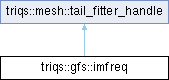
| Public Member Functions inherited from triqs::mesh::tail_fitter_handle | |
| tail_fitter & | get_tail_fitter () const |
| Get the triqs::mesh::tail_fitter object. | |
| tail_fitter & | get_tail_fitter (double tail_fraction, int n_tail_max=tail_fitter::default_n_tail_max, std::optional< int > expansion_order={}) const |
| Construct a new triqs::mesh::tail_fitter object with the given parameters and return it. | |
| void | set_tail_fit_parameters (double tail_fraction, int n_tail_max=tail_fitter::default_n_tail_max, std::optional< int > expansion_order={}) const |
| Set the pointer to a new tail-fitter object constructed with the given parameters. | |
Static Public Member Functions | |
| static std::string | hdf5_format () |
| Get the HDF5 format tag. | |
Friends | |
| void | h5_read (h5::group g, std::string name, imfreq &m) |
| Read a triqs::mesh::imfreq mesh from HDF5. | |
| void | h5_write (h5::group g, std::string name, imfreq const &m) |
| Write a triqs::mesh::imfreq mesh to HDF5. | |
| std::ostream & | operator<< (std::ostream &sout, imfreq const &m) |
| Write a triqs::mesh::imfreq mesh to a std::ostream. | |
Member Enumeration Documentation
◆ option
|
strong |
Enum to specify which frequencies should be included in the mesh.
The following options are supported:
- all_frequencies: Include negative and positive frequencies.
- positive_frequencies_only: Include only positive frequencies.
Definition at line 167 of file imfreq.hpp.
Constructor & Destructor Documentation
◆ imfreq() [1/2]
|
inline |
Construct an imaginary frequency mesh with \( N_{i\omega_n} \geq 0 \) positive Matsubara frequencies.
- Parameters
-
beta Inverse temperature \( \beta > 0 \). statistic Particle statistics. n_iw Number of positive Matsubara frequencies, i.e. \( N_{i\omega_n} \). opt Whether to use all or only the positive frequencies.
Definition at line 181 of file imfreq.hpp.
◆ imfreq() [2/2]
|
inline |
Construct an imaginary frequency mesh with a threshold for the largest positive Matsubara frequency on the mesh.
The number of positive Matsubara frequencies is related to the threshold \( \omega_{\text{max}} \) by
\[ N_{i\omega_n} = \begin{cases} \left\lfloor \frac{\omega_{\text{max}} \beta / \pi - 1}{2} \right\rfloor & \text{if fermionic statistics} \\ \left\lfloor \frac{\omega_{\text{max}} \beta / \pi}{2} \right\rfloor & \text{if bosonic statistics} \\ \end{cases} \; . \]
- Parameters
-
beta Inverse temperature \( \beta > 0 \). statistic Particle statistics. w_max Threshold \( \omega_{\text{max}} > 0 \) for the largest positive Matsubara frequency. opt Whether to use all or only the positive frequencies.
Definition at line 206 of file imfreq.hpp.
Member Function Documentation
◆ deserialize()
|
inline |
Deserialize the mesh from a generic archive.
- Parameters
-
ar Archive to deserialize from.
Definition at line 390 of file imfreq.hpp.
◆ is_index_valid()
|
inlinenodiscard |
Check if a Matsubara index \( n \) is valid.
- Parameters
-
n Matsubara index \( n \) to check.
- Returns
- True if \( n_\text{min} \leq n \leq n_\text{max} \), false otherwise.
Definition at line 221 of file imfreq.hpp.
◆ operator()()
|
inlinenodiscard |
Function call operator to access a mesh point by its Matsubara index \( n \in \{ n_{\text{min}}, \dots, n_{\text{max}} \} \).
- Parameters
-
n Matsubara index \( n \) of the mesh point.
- Returns
- mesh_point_t with the Matsubara index \( n \), data index \( d(n) = n - n_{\text{min}} \) and same \( \beta \), particle statistics and hash value as the current mesh.
Definition at line 308 of file imfreq.hpp.
◆ operator[]() [1/2]
|
inlinenodiscard |
Subscript operator to access a mesh point by a Matsubara frequency \( i\omega_n \) contained in a triqs::mesh::closest_mesh_point_t.
- Parameters
-
cmp triqs::mesh::closest_mesh_point_t containing \( i\omega_n \).
- Returns
- mesh_point_t with the Matsubara index \( n(i\omega_n) = n \), data index \( d(i\omega_n) = n - n_{\text{min}} \) and same \( \beta \), particle statistics and hash value as the current mesh.
Definition at line 298 of file imfreq.hpp.
◆ operator[]() [2/2]
|
inlinenodiscard |
Subscript operator to access a mesh point by its data index \( d \in \{0, 1, \ldots, N-1\} \).
- Parameters
-
d Data index \( d \) of the mesh point.
- Returns
- mesh_point_t with the Matsubara index \( n(d) = d + n_{\text{min}} \), data index \( d \) and same \( \beta \), particle statistics and hash value as the current mesh.
Definition at line 288 of file imfreq.hpp.
◆ serialize()
|
inline |
Serialize the mesh to a generic archive.
- Parameters
-
ar Archive to serialize to.
Definition at line 384 of file imfreq.hpp.
◆ to_data_index() [1/3]
|
inlinenodiscard |
Map a Matsubara frequency \( i\omega_n \) contained in a triqs::mesh::closest_mesh_point_t to its data index \( d(i\omega_n) \).
- Parameters
-
cmp triqs::mesh::closest_mesh_point_t containing \( i\omega_n \).
- Returns
- Data index \( d(i\omega_n) = n - n_{\text{min}} \).
Definition at line 253 of file imfreq.hpp.
◆ to_data_index() [2/3]
|
inlinenodiscardnoexcept |
Map a Matsubara index \( n \in \{ n_{\text{min}}, \dots, n_{\text{max}} \} \) to its corresponding data index \( d(n) \).
- Parameters
-
n Matsubara index \( n \) to map.
- Returns
- Data index \( d(n) = n - n_{\text{min}} \).
Definition at line 230 of file imfreq.hpp.
◆ to_data_index() [3/3]
|
inlinenodiscardnoexcept |
Map a Matsubara frequency \( i\omega_n \) to its data index \( d(i\omega_n) \).
- Parameters
-
iw Matsubara frequency to map.
- Returns
- Data index \( d(i\omega_n) = n - n_{\text{min}} \).
Definition at line 241 of file imfreq.hpp.
◆ to_index() [1/2]
|
inlinenodiscard |
Map a Matsubara frequency \( i\omega_n \) contained in a triqs::mesh::closest_mesh_point_t to its Matsubara index \( n(i\omega_n) \).
- Parameters
-
cmp triqs::mesh::closest_mesh_point_t containing \( i\omega_n \).
- Returns
- Matsubara index \( n(i\omega_n) = n \).
Definition at line 276 of file imfreq.hpp.
◆ to_index() [2/2]
|
inlinenodiscard |
Map a data index \( d \in \{0, 1, \ldots, N-1\} \) to the corresponding Matsubara index \( n(d) \).
- Parameters
-
d Data index \( d \) to map.
- Returns
- Matsubara index \( n(d) = d + n_{\text{min}} \).
Definition at line 264 of file imfreq.hpp.
◆ to_value()
|
inlinenodiscard |
Map a Matsubara index \( n \in \{ n_{\text{min}}, \dots, n_{\text{max}} \} \) to its corresponding Matsubara frequency \( i\omega_n \).
- Parameters
-
n Matsubara index \( n \) to map.
- Returns
- Matsubara frequency \( i\omega_n \).
Definition at line 317 of file imfreq.hpp.
Friends And Related Symbol Documentation
◆ h5_read
|
friend |
Read a triqs::mesh::imfreq mesh from HDF5.
- Parameters
-
g h5::group to be read from. name Name of the subgroup. m Mesh object to be read into.
Definition at line 418 of file imfreq.hpp.
◆ h5_write
|
friend |
Write a triqs::mesh::imfreq mesh to HDF5.
- Parameters
-
g h5::group to be written to. name Name of the subgroup. m Mesh object to be written.
Definition at line 402 of file imfreq.hpp.
◆ operator<<
|
friend |
Write a triqs::mesh::imfreq mesh to a std::ostream.
- Parameters
-
sout std::ostream object. m Mesh to be written.
- Returns
- Reference to std::ostream object.
Definition at line 374 of file imfreq.hpp.
The documentation for this class was generated from the following file:
- triqs/mesh/imfreq.hpp