#include <triqs/mesh/imtime.hpp>
Detailed Description
Imaginary time mesh type.
An imaginary time mesh is defined by its size \( N \geq 0 \), an inverse temperature \( \beta > 0 \) and its particle statistics. It contains \( N \) equally spaced mesh points on the interval \( [0, \beta] \) such that the distance between two consecutive mesh points (step size) is constant.
An imaginary time mesh has the following properties:
- Each mesh point is identified by a unique index \( n \in \{0, 1, \ldots, N-1\} \).
- An index \( n \) is mapped to the corresponding data index \( d \) by the identity function \( d(n) = n \) and vice versa.
- An index \( n \) is mapped to the corresponding value \( \tau \) by the linear function \( \tau(n) = n \cdot \Delta \) such that \( \tau(0) = 0 \) and \( \tau(N-1) = \beta \). The step size of the mesh is \( \Delta = \frac{\beta}{N - 1} \) for \( N > 1 \), otherwise it is undefined. For implementation purposes, we set \( \Delta = 0 \) and \( \Delta^{-1} = 0 \) for \( N = 0 \) and \( \Delta = 0 \) and \( \Delta^{-1} = \infty \) for \( N = 1 \).
- An arbitrary value \( \tau \in [0, \beta] \) is mapped to the closest mesh point with index \( n \) by the function \( n(\tau) = \left\lfloor \frac{\tau}{\Delta} + 0.5 \right\rfloor \).
Green's function containers that are based on an imaginary time mesh store the function values at the discrete time points \( \tau(n) \), i.e. \( f_n = f(\tau(n)) \), and use linear interpolation to evaluate the function at an arbitrary imaginary time \( \tau \in [0, \beta] \).
Definition at line 68 of file imtime.hpp.
Public Types | |
| using | mesh_point_t = detail::linear<imtime, double>::mesh_point_t |
| Mesh point type of a triqs::mesh::imtime mesh (see triqs::mesh::detail::linear::mesh_point_t). | |
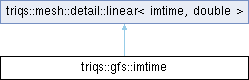
| Public Types inherited from triqs::mesh::detail::linear< imtime, double > | |
| using | data_index_t |
| Data index type. | |
| using | index_t |
| Index type. | |
| using | value_t |
| Value type. | |
Public Member Functions | |
| imtime (double beta=1.0, statistic_enum statistic=Fermion, long n_tau=0) | |
| Construct an imaginary time mesh on the interval \( [0, \beta] \) with \( N \geq 0 \) equally spaced mesh points and the given particle statistics. | |
| double | beta () const noexcept |
| Get the inverse temperature \( \beta \). | |
| void | deserialize (auto &ar) |
| Deserialize the mesh from a generic archive. | |
| bool | operator== (imtime const &) const=default |
| Equal-to comparison operator compares \( N \), \( \beta \) and the particle statistics. | |
| void | serialize (auto &ar) const |
| Serialize the mesh to a generic archive. | |
| statistic_enum | statistic () const noexcept |
| Get the particle statistics. | |
| Public Member Functions inherited from triqs::mesh::detail::linear< imtime, double > | |
| linear ()=default | |
| Default construct an empty linear mesh of size \( N = 0 \). | |
| auto | begin () const |
| Get an iterator to the beginning of the mesh. | |
| auto | cbegin () const |
| Get a const iterator to the beginning of the mesh. | |
| auto | cend () const |
| Get a const iterator to the end of the mesh. | |
| value_t | delta () const noexcept |
| Get the step size \( \Delta \) of the mesh, i.e. the distance between two consecutive mesh points. | |
| value_t | delta_inv () const noexcept |
| Get the inverse of the step size of the mesh, i.e. \( 1 / \Delta \). | |
| void | deserialize (auto &ar) |
| Deserialize the mesh from a generic archive. | |
| auto | end () const |
| Get an iterator to the end of the mesh. | |
| auto | evaluate (auto const &f, double x) const |
| Linear interpolation of a function \( f \) defined on a triqs::mesh::detail::linear mesh at a value \(x \in [a, b] \). | |
| long | first_index () const |
| Get the first index of the mesh, i.e. \( 0 \). | |
| bool | is_index_valid (index_t n) const noexcept |
| Check if an index \( n \) is valid. | |
| long | last_index () const |
| Get the last index of the mesh, i.e. \( N - 1 \). | |
| uint64_t | mesh_hash () const noexcept |
| Get the hash value of the mesh. | |
| mesh_point_t | operator() (index_t n) const noexcept |
| Function call operator to access a mesh point by its index \( n \in \{0, 1, \ldots, N-1\} \). | |
| bool | operator== (linear const &rhs) const=default |
| Equal-to comparison operator compares \( N \) and the interval \( [a, b] \). | |
| mesh_point_t | operator[] (long d) const noexcept |
| Subscript operator to access a mesh point by its data index \( d \in \{0, 1, \ldots, N-1\} \). | |
| void | serialize (auto &ar) const |
| Serialize the mesh to a generic archive. | |
| long | size () const noexcept |
| Get the size \( N \) of the mesh, i.e. the number of mesh points. | |
| data_index_t | to_data_index (index_t n) const noexcept |
| Map an index \( n \in \{0, 1, \ldots, N-1\} \) to its corresponding data index \( d(n) \). | |
| index_t | to_index (data_index_t d) const noexcept |
| Map a data index \( d \in \{0, 1, \ldots, N-1\} \) to the corresponding index \( n(d) \). | |
| value_t | to_value (index_t n) const noexcept |
| Map an index \( n \in \{0, 1, \ldots, N-1\} \) to its corresponding value \( m(n) \). | |
Static Public Member Functions | |
| static std::string | hdf5_format () |
| Get the HDF5 format tag. | |
Friends | |
| void | h5_read (h5::group g, std::string const &name, imtime &m) |
| Read a triqs::mesh::imtime mesh from HDF5. | |
| void | h5_write (h5::group g, std::string const &name, imtime const &m) |
| Write a triqs::mesh::imtime mesh to HDF5. | |
| std::ostream & | operator<< (std::ostream &sout, imtime const &m) |
| Write a triqs::mesh::imtime mesh to a std::ostream. | |
Additional Inherited Members | |
| Protected Member Functions inherited from triqs::mesh::detail::linear< imtime, double > | |
| void | h5_read_impl (h5::group g, std::string const &name, const char *exp_format) |
| Read the mesh from HDF5. | |
| void | h5_write_impl (h5::group g, std::string const &name, const char *format) const |
| Write the mesh to HDF5. | |
Constructor & Destructor Documentation
◆ imtime()
|
inline |
Construct an imaginary time mesh on the interval \( [0, \beta] \) with \( N \geq 0 \) equally spaced mesh points and the given particle statistics.
- Parameters
-
beta Inverse temperature \( \beta > 0 \). statistic Particle statistics. n_tau Size of the mesh.
Definition at line 82 of file imtime.hpp.
Member Function Documentation
◆ deserialize()
|
inline |
Deserialize the mesh from a generic archive.
- Parameters
-
ar Archive to deserialize from.
Definition at line 106 of file imtime.hpp.
◆ serialize()
|
inline |
Serialize the mesh to a generic archive.
- Parameters
-
ar Archive to serialize to.
Definition at line 97 of file imtime.hpp.
Friends And Related Symbol Documentation
◆ h5_read
|
friend |
Read a triqs::mesh::imtime mesh from HDF5.
- Parameters
-
g h5::group to be read from. name Name of the subgroup. m Mesh object to be read into.
Definition at line 136 of file imtime.hpp.
◆ h5_write
|
friend |
Write a triqs::mesh::imtime mesh to HDF5.
- Parameters
-
g h5::group to be written to. name Name of the subgroup. m Mesh object to be written.
Definition at line 121 of file imtime.hpp.
◆ operator<<
|
friend |
Write a triqs::mesh::imtime mesh to a std::ostream.
- Parameters
-
sout std::ostream object. m Mesh to be written.
- Returns
- Reference to std::ostream object.
Definition at line 157 of file imtime.hpp.
The documentation for this class was generated from the following file:
- triqs/mesh/imtime.hpp